
1.6 Cost and lead-time drivers without the math
The final price of an electronic assembly is not determined by a random markup; it is a summation of physical complexity and supply chain risk. Two PCBA designs may look identical to the naked eye—same size, green solder mask, similar components—yet one costs $15 and ships in 3 weeks, while the other costs $45 and ships in 40 weeks. Understanding the specific levers that drive cost and time allows engineering teams to eliminate them from the product before freezing the design.
1. The BOM: the main cost driver
Section titled “1. The BOM: the main cost driver”In almost every EMS project, 70% to 80% of the total unit price is the raw cost of the components (
The driver: sole sourcing vs. multi-sourcing
Section titled “The driver: sole sourcing vs. multi-sourcing”- Standard Parts: A generic 10kΩ resistor is a commodity. When Brand A is out of stock, the factory simply buys Brand B. The cost is low, and the lead time is measured in days.
- Sole Source Parts: A specialized sensor or a specific microcontroller is often available from only one manufacturer.
- The Risk: A critical chip carrying a 52-week lead time delays the entire product launch by a year, regardless of assembly factory speed. Furthermore, sole-manufacturer
obsolescence forces an immediate and costly board redesign.
2. PCB technology: layers and density
Section titled “2. PCB technology: layers and density”The
The driver: HDI and via structure
Section titled “The driver: HDI and via structure”- Standard: A 4-layer board with standard “through-hole” vias (holes drilled entirely through the board) is cost-effective and robust.
- Advanced: “Blind” or “Buried” vias (holes connecting internal layers without penetrating the whole board) require precise laser drilling and sequential lamination.
- The Risk: Designing with High Density Interconnect (HDI) features unnecessarily can easily triple the raw PCB cost.
3. Assembly complexity: machine vs. hand
Section titled “3. Assembly complexity: machine vs. hand”Automated machines are fast and cost-efficient; manual human labor is generally slow and expensive.
The driver: through-hole vs. SMT
Section titled “The driver: through-hole vs. SMT”- SMT (
Surface Mount Technology ): Pick & Place machines can place upwards of 30,000 components per hour. This is the most efficient way to build a PCBA. Through-Hole : Requires component leads to be inserted into holes. While some of this process can be automated, odd-shaped connectors or heavy transformers often require manual insertion by an operator.- The Risk: Replacing a standard surface-mount USB connector with a custom through-hole version automatically adds manual labor cost to every single unit produced.
The driver: single vs. double sided
Section titled “The driver: single vs. double sided”- The Risk: Placing components on both sides of the board requires the PCBA to run through the SMT production line twice (two
solder paste printing cycles, two placement cycles, and tworeflow soldering cycles), which effectively doubles the SMT processing time.
4. Test and yield: the hidden tax
Section titled “4. Test and yield: the hidden tax”“Yield” measures the percentage of units that pass inspection on the first try. “Scrap” represents the physical material and money that is thrown away.
The driver: first pass yield (FPY)
Section titled “The driver: first pass yield (FPY)”For example, if a board costs $100 to build, a 90% yield effectively wastes $10 for every successfully shipped unit. Ultimately, the end customer subsidizes both the good units and the scrapped ones.
- The Risk: Designs utilizing unnecessarily complex features (like extremely tight clearances or micro-pads) directly lower the
First Pass Yield (FPY). Consequently, the unit price rises proportionately to cover the cost of the wasted material.
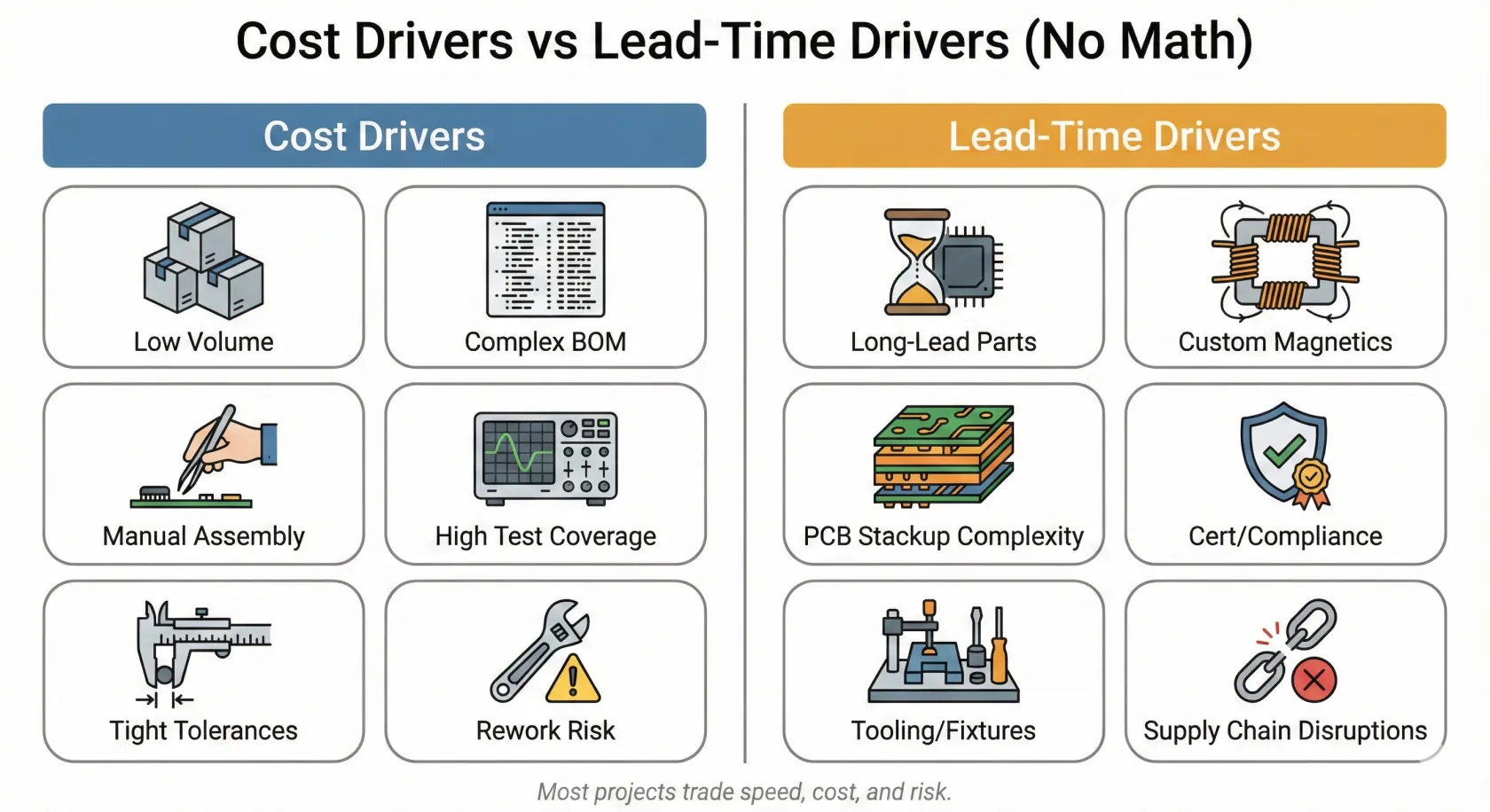
5. The “open book” quoting model
Section titled “5. The “open book” quoting model”Traditionally, manufacturers provided “Black Box” pricing without breakdown. Customers remained unaware whether a $50 unit comprised $10 in material with $40 in profit, or $45 in material with $5 in profit.
The solution: open BOM transparency
Section titled “The solution: open BOM transparency”Modern EMS engagements utilize “Open Book” pricing. The EMS explicitly lists the cost of every single component, their hourly labor rate, and their profit margin.
- Benefit: Transparency directly empowers engineering decisions. Identifying a specific $4.00 connector artificially driving up the total price creates the immediate opportunity to design it out.
- Control: It prevents “phantom markups” where a supplier might pad the cost of cheap, generic resistors.
Pro-Tip: Requesting the “Long Lead Item” (LLI) report from the EMS during the initial quoting phase is highly recommended. This highlights the single component dictating the critical path schedule. Often, changing one specific capacitor saves 20 weeks of waiting.
Final Checkout: Cost and lead-time drivers without the math
Section titled “Final Checkout: Cost and lead-time drivers without the math”| Driver | Low Cost / Low Risk | High Cost / High Risk | Action |
|---|---|---|---|
| Components | Generic, Multi-sourced | Sole Source, Proprietary | Validate alternates inside the BOM. |
| PCB | 2-6 Layers, Standard Vias | HDI, Blind/Buried Vias, 10+ Layers | Stick to standard stack-ups unless necessary. |
| Assembly | Single-sided SMT | Double-sided, Heavy Through-hole | Minimize manual insertion parts. |
| Testing | Automated (ICT/ | Manual Troubleshooting | Design proper test points onto the board early. |
| Logistics | Sea Freight (4-6 weeks) | Air Freight (3-5 days) | Plan inventory early to avoid expensive air shipping fees. |