
1.3 Who does what: OEM, EMS, ODM
Manufacturing relationships are ultimately guided by a single, foundational question: Who owns the Intellectual Property? A clear understanding of these industry roles is essential for a successful manufacturing strategy. Expecting an EMS to design a product from scratch will lead to significant project delays, while expecting an ODM to hand over their proprietary design files can create serious legal complications. Clarity on these roles defines exactly who controls the engineering data and who carries the financial liability when issues occur.
OEM (original equipment manufacturer)
Section titled “OEM (original equipment manufacturer)”Role: the architect and the brand
Section titled “Role: the architect and the brand”The OEM is the company that conceives the product, owns the brand identity, and ultimately sells the device to the end customer. They are responsible for determining the “what” and the “why” of the product.
The engineering reality
Section titled “The engineering reality”As an OEM, the company owns all the core design data, including Gerbers, the Bill of Materials (BOM), and the source code. Consequently, the OEM takes full responsibility for the product’s market success as well as its regulatory certification and compliance.
The Risk: Should the product design contain fundamental engineering flaws, the OEM is responsible for the resulting rework or scrap costs. The factory’s primary role is to execute the design exactly as provided, not to correct design decisions.
- Primary Asset: The Intellectual Property and brand reputation.
- Key Risk: Misjudging market demand or the actual physical feasibility of the design.
EMS (electronics manufacturing services)
Section titled “EMS (electronics manufacturing services)”Role: the builder
Section titled “Role: the builder”An EMS provider sells their manufacturing capacity, deep process expertise, and supply chain management capabilities. It is helpful to understand that they do not design products; instead, they precisely execute the designs provided to them. They serve as the physical “hands” of the operation.
The engineering reality
Section titled “The engineering reality”The core responsibility of the EMS is to ensure consistent process compliance. An EMS performing exact component placement according to OEM instructions fulfills their fundamental responsibility, even if that specified location proves electronically incorrect for the circuit’s function.
The Liability Interface:
-
Whenever the Pick & Place machine places a part inaccurately on the board, the EMS is financially liable for the defect.
-
Whenever the machine accurately places the wrong part because that incorrect part was specified in the BOM, the OEM is financially liable.
-
Primary Asset: Optimized SMT lines, trained operators, and rigorous Process Control Standards.
-
Key Risk: Capital equipment underutilization (idle lines) and low process yields.
ODM (Original Design Manufacturer)
Section titled “ODM (Original Design Manufacturer)”Role: the creator-for-hire
Section titled “Role: the creator-for-hire”The ODM actively designs and manufactures complete products that are often sold under another company’s brand. They maintain an extensive catalog of pre-designed “white label” products—such as standard WiFi routers or phone chargers—which are easily customized with specific brand identities.
The engineering reality
Section titled “The engineering reality”Engaging an ODM involves purchasing a finished product off the shelf, rather than funding bespoke invention. Because of this, the purchasing company does not own the fundamental design files. The core IP belongs entirely to the ODM.
The Risk: Moving production to an alternative facility in the future requires a complete redesign from scratch, as the original ODM entirely retains all of their design rights.
- Primary Asset: A vast, proven library of ready-to-sell product designs.
- Key Risk: Losing market share to competitors who might be purchasing the exact same generic product from the same ODM.
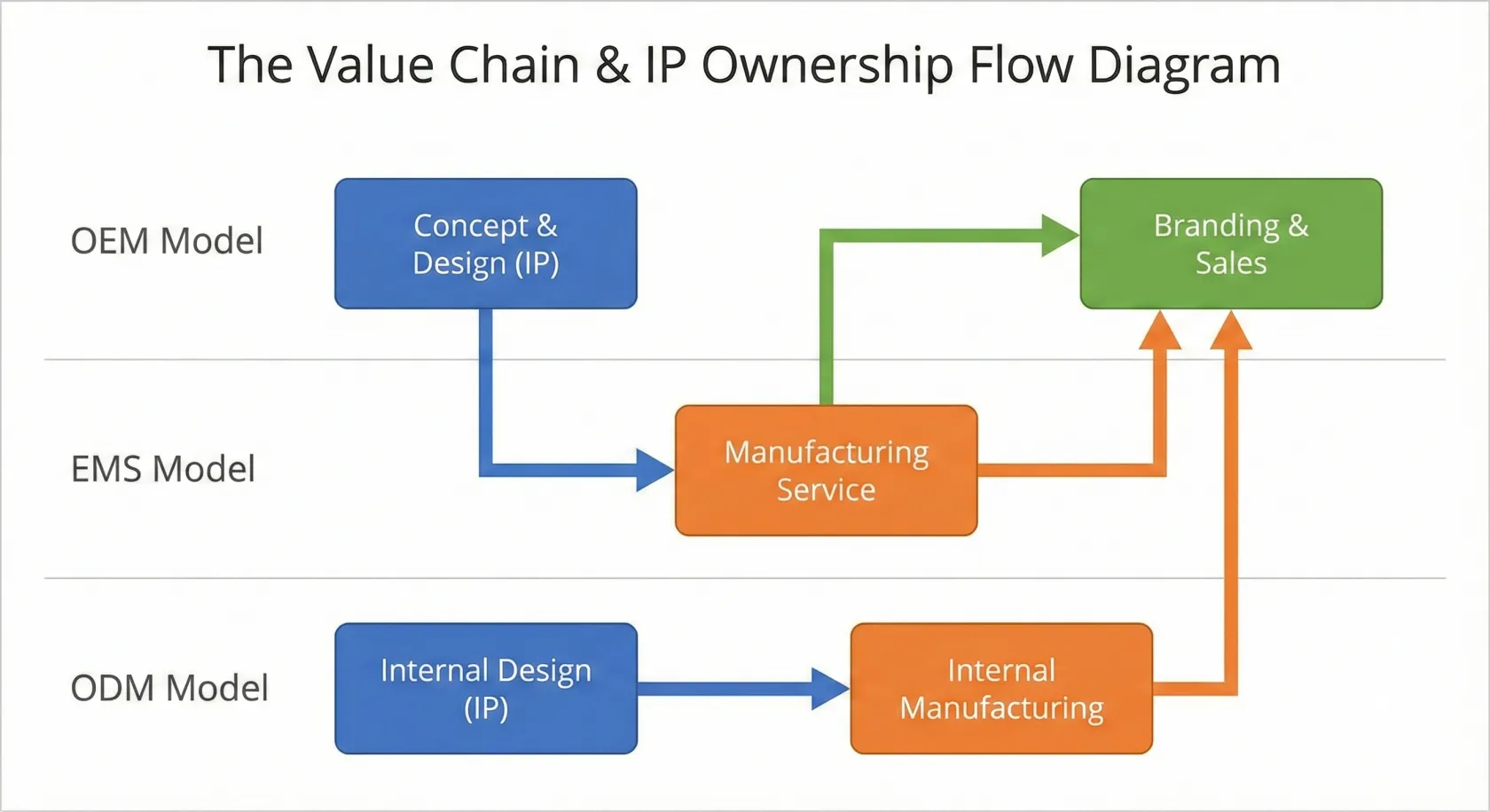
Recap: OEM, EMS, ODM Role Clarification
Section titled “Recap: OEM, EMS, ODM Role Clarification”| Role | IP Ownership | Primary Engineering Responsibility | Financial Liability for Defects |
|---|---|---|---|
| OEM | Owns all core design data (Gerbers, BOM, source code). | Product design, specification correctness, and regulatory compliance. | Design/specification errors (e.g., wrong part in BOM). |
| EMS | None. Executes designs provided by OEM. | Process compliance and execution accuracy (e.g., component placement). | Execution errors (e.g., inaccurate part placement). |
| ODM | Owns all design IP; not transferred to customer. | Readiness and reliability of serial product from their design library. | Warranty for the standard product as supplied. |